Showing posts with label terrain. Show all posts

11 September 2016

Terrain pieces

While the actual models take the priority for me as well as most people, I sometimes like to take the time to make some new terrain pieces, too. After all, they do have a huge effect on the visual appeal of a game, possibly even more so than the models.
This time around, I decided to make a couple of new trees, one of them by itself, the other connected to a barb wire barrier.
GW's resin skull sprue comes with a few ready-made piles of skulls, for which I have some trouble finding a use in basing. For this one, I decided to have a small tree growing over and around them. Maybe the tree was planted over a shallow mass grave, or maybe the scene speaks of a less than wholesome ritual. I'm not making a declaration one way or another.
With my previous tree, I found the branches didn't exactly look like coniferous trees, as they were a little too thin and regular shaped. I decided to glue some sand to the branches on this one.
The extra bulk brought by the sand made the brances look a lot better and more coniferous.
I used Doombull Brown to drybrush the bark, which, through the red tint, gave the tree a lot more pine-like appearance.


I plan to append this post a few times. The other terrain piece is still unpainted and will remain a lower priority for the time being, but I do intend to finish it.

17 June 2016

Cathedral Wall Backdrop, main structure

Foamboard may be one of the easiest terrain building materials, but it still certainly takes some time to learn to make anything out of it. I have been building this terrain piece occasionally, but the progress has been fairly slow. Fortunately, I have enough material and it's cheap enough to waste some of it on some occasional mistakes.
After the previous post, I tried to make the previous flying buttresses a little thicker, but just couldn't get them to look right. Eventually, I decided they just needed to be remade. The new ones are somewhat more elaborate, constructed in two pieces each.
I also added a windowsill and some pieces of wood to frame the window.
 The windowsill came from GW's Cities of Death Floor Pack, which I intend to use some more on this project, too. The flying buttresses are still uneven, as can be seen on the right.

After fixing a few minor issues, the next step will be to work on the decoration. I have some plans regarding that, but I'll leave that information to myself for now.

10 January 2016

Imperial Chapel, early stage build

With the basic building elements cut out, the next stage was to start putting them together. It became immediately apparent that the pillars at each corner made things significantly more complicated that just a cubical construction would have done. The octagonal shape calls for a whole bunch of various calculations, and making the pillars solid is a challenge by itself.
 Even though I thought I was making a modestly-sized building with 15 cm wall length, it turned out to be relatively large when I tried to fit it in the box I use for photographing my models.
The pillars were made by cutting 175 mm x 80 mm pieces of foamcore and then dividing it into eight 10 mm wide and 175 mm long strips. I then cut the paper on the outside of each strip so that I could fold them inwards, making a pillar with an octagonal profile.  For the time being, I use tape to keep the pillars in shape, but will have to think of a more permanent solution.
As you can see, I used sewing needles to pin the pieces in place while waiting for the PVA glue to dry.
 The two collapsed pillars were made similarly, only cut irregularly at certain height. I plan to use the pieces I cut out of the wall elements for rubble later on.
I also started working on the interior. The walkway is placed so that models on it can fire out of the large, circular window. I'm thinking of adding stairs that lead to it, though the placement of the windows may make that challenging.

8 January 2016

Imperial Chapel, first pieces

As I mentioned last week, I got a hold of some foamboard, or foamcore, to be more precise, and am now starting a project to build something out of it.
I haven't previously worked with the stuff, so this playlist on TerrainTutor's channel on YouTube helped immensely with getting started.
As I mentioned it might be, my first project is going to be an Imperial chapel for 40k. As with many projects, the first thing to do was research. I ended up loosely basing my chapel-to-be on the Gothic chapel in Peterhof.
 The white foamcore board in front of the white background isn't very clearly visible, but there's not much yet to see, anyway. This is the front wall of the chapel, with a quinto acuto arch on the doorway (the center of both arcs is one fifth of the width short of the opposite edge).
 The windows on the intact side (one of the walls will be mostly collapsed, to gve access to the building) are similar to the recto style (the centers of the archs one fourth forward from the opposite edge), but I used five as the number instead of four.
 The collapsed side, with a partially collapsed tower. Two of the towers will be damaged, while the other two will be intact. The two damaged ones will be on either side of the collapsed wall. The roof will be about half collapsed, possibly more, depending on how much room is needed so that about a normal-sized hand can fit in the building to move the models.
The back wall will have a large, round window, with a catwalk or a ledge behind it so that it can be used as a firing position. Round, decorative windows are very typical to gothic style architecture.

There's a lot more to do, but those are the four walls, around which the chapel will be built. I have no idea how long this project will be, but I plan to sculpt at least one major statue, possibly three or more, to decorate it, in addition to the building itself. I haven't decided on a schedule yet, but considering how fragile the foamboard and how dangerous place my desk is, I think it will have to be completed in a fairly short order.

1 January 2016

Some barricades, and plans for 2016

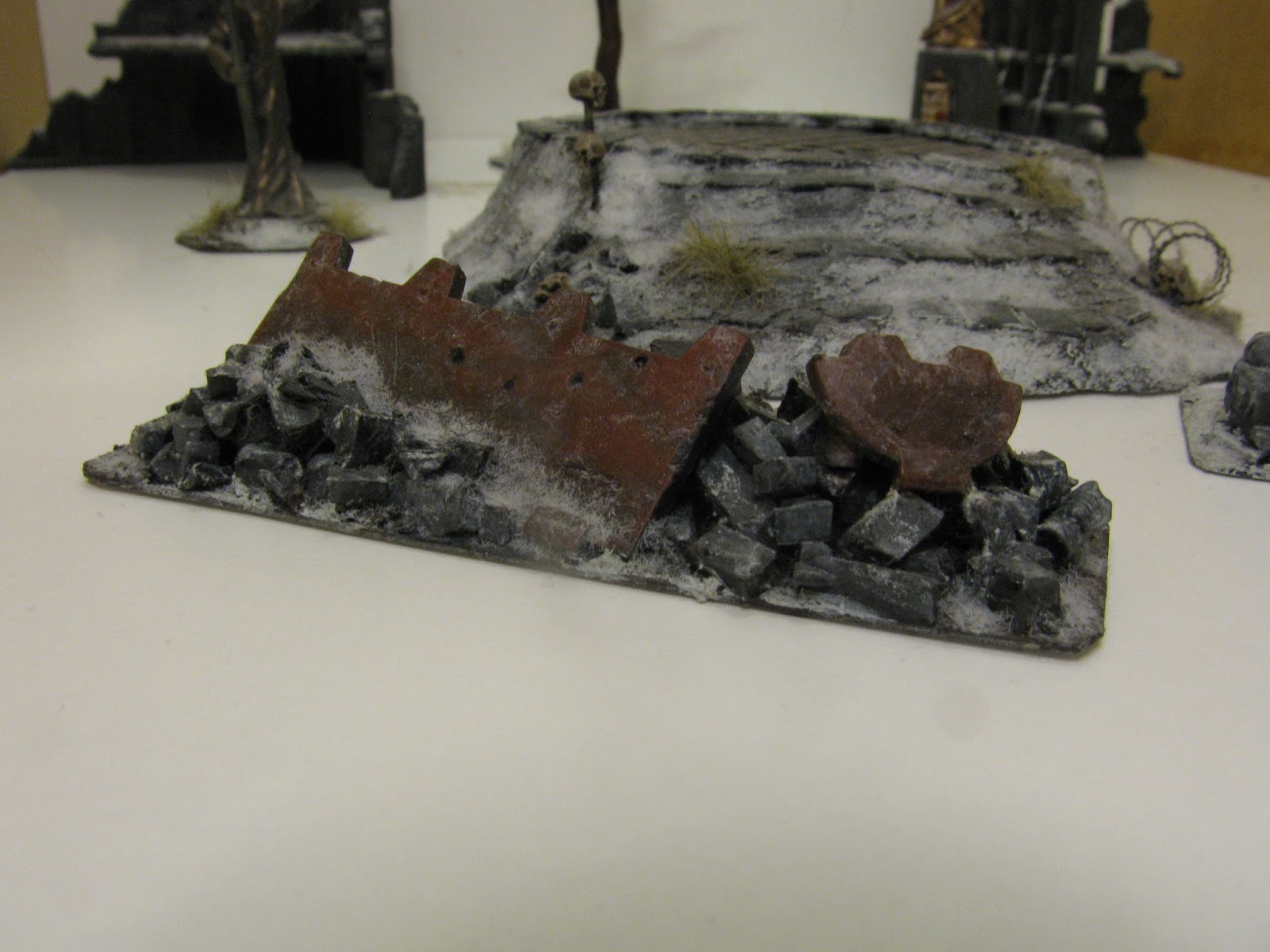
According to a lot of people who do terrain building, it's best to start small, pick up the skills you need and then move on to larger projects. With this in mind, I made a couple of small barricades way back.
  The bulk of the barricades was made simply by snipping off small pieces of sprue and gluing them on a piece of plasticard. I then went on to glue some extra bits leftover from various kits on top of this.
The arch on this one is from a piece of old Games Workshop's ruins. I also sculpted a couple of sandbags and added a hatch from an old Leman Russ kit from when I collected Catachans in the late 90s.
The larger sliding door is from the Rhino kit, as well as the half of the hatch. I painted all the metal parts with Leadbelcher and then applied Orange Rust rather liberally on top of that. I finished the barricades with modelling snow to make them fit in with my basing style. 
The biggest issue I have with these barricades is that in hindsight, the rectangular pieces of plasticard I built them on were too regular in shape and stick out somewhat. I'd recommend using rounder shapes instead, preferably with some irregularities.

The title mentions that I have some plans for this year, and they're related to these by the way of terrain building. I managed to get my hands on some foamcore, ie. the stuff that hobbyists most like to build terrain out of, and intend to start some sort of build at some point. What it will be, I'm not certain, but I'm thinking of a small Imperial chapel. Depending on how small, it may actually become a multi-part series.

3 December 2015

Tree, painted

I decided the set I use to photograph my miniatures could use some more stuff in the background, and started to look into making terrain pieces. I follow Mel the Terrain Tutor on YouTube, and among his videos, found one on how to make miniature trees out of wire. I keep various gauges of wire handy all the time for Green Stuff armatures, so I decided to give it a try.
 The process for making the tree armature was simple enough, and Mel explains it better than I could on the video linked above.
The next step was covering the armature with modelling putty and somewhat hiding the wire construction. I used Green Stuff for this, though it honestly may not be the best material for this, as you really don't need too fine detail for this. Of course, I forgot to take a picture of this stage, but there wouldn't have been that much to see, other than the shape of the tree below, only green and without the conifers/foliage.
I also glued the tree onto a base made out of plasticard, with some pieces of cork under it to look like it's growing out of rocky ground.
Here's the tree painted, varnished etc. In a word, finished. I wanted my tree to look coniferous, so I tried out something different from Mel's videos, and glued some Gale Force Nine Coniferous Flock Blend to the branches, instead of using lichen.
I would call the experiment a moderate success. It doesn't look quite as much like a pine tree as I had hoped, but all in all, I'd say it does the job.
Having finished with the actual tree, I finalized the base by painting in my usual style.
I intend to make another tree at some point, but will probably try out some putty other than green stuff, which I believe is better used elsewhere. For the next tree, I'm planning to add some eye-catching details that would be at home on a battlefield. I'm afraid I can't be more specific, because I don't even know myself what will those be. I'll think of something.

20 September 2015

Imperial statue, painted

I thought the box I use for a set could use some more decoration (as well as some vacuuming, but that's beside the point, not to mention not done yet), so I decided to finish the statue I had made.

I wanted the parchment hanging off the statue to have one of those large, decorative capital letters, sometimes seen in Medieval manuscripts. I chose T because of its simple, symmetric shape. I like to imagine the parchment has the lyrics for AC/DC's Thunderstruck, which the Imperial faithful then sing as a Gregorian-style chant.
I had originally planned to paint the statue to look like it's made of weathered bronze, but I noticed the picture this was inspired by featured what looks like a golden statue, so I decided to go for gold, too. It looks a lot darker in the pictures than in real life, which suggests that I could use a little more light on the set. Will look into that.
Getting the snow on the statue look right turned out to be a lot trickier than I thought. At first, I tried to spray a little varnish over it directly from above and then sprinkle the model snow over it, but it didn't really work. Then, I tried to figure out where the snow would naturally collect and place it there, but I wasn't too crazy about the result then, either. It seems like Citadel's snow is too thick to be used like this. I have to take a look at the alternatives, such as Woodland Scenics, when I get the chance.

13 September 2015

Imperial statue terrain piece

This piece was inspired by a picture in the 40k 7th edition rulebook. If you have seen the picture, you probably recognised it as soon as you saw the photos. It's not a perfect copy, obviously; the eagle warrior thingy in the rulebook is clearly moving and shouting (screeching?). I did consider sculpting the eagle's mouth open, but decided it would be too fiddly and would limit my posing options later on.
 Finding the right set of legs proved a challenge. At first, I was going to just use a standard Space Marine's legs, but those tend to have too wide stances and would have made the model look more static. Running legs were an option, but there are rarely any of those to spare when your main army is Ragnar Blackmane's Great Company. In the end, I ended up just sculpting an approximation of the legs and covering them with cloth.
 The bolter is the ornamental one from the Command Squad set. There are few uses for a vanilla marine ornamented bolter with Space Wolves, and I decided this would be the best use for it.
I use wine bottle corks to hold my sculpts while I'm working on them, so the pedestal was easy enough to find. I decided to add some sprue rubble (small bits cut from a sprue) and a resin skull to the plasticard base and glued a litany scroll I had lying around to the pedestal.

Painting this should be simple, as I see the main figure to be a single piece of bronze and the pedestal being stone. The only part that takes any accuracy really will be the litany scroll with the purity seal.

13 August 2015

The stage is set...

After what seemed like ages, I finally managed to build a set for my miniatures to appear on. I felt like just having them on a dirty piece of MDF would have been dull, so I bought some modelling clay and used it, a piece of aluminum mesh and some decorative effects to make a sort of a platform. I'm fairly certain this won't be the final form of this set, but it is a start.